

 English
  Français
  Português
 Home / News / Industry News / How Does Emulsified Silicone Oil Improve Industrial Process Efficiency
 How Does Emulsified Silicone Oil Improve Industrial Process Efficiency
2026-06-01
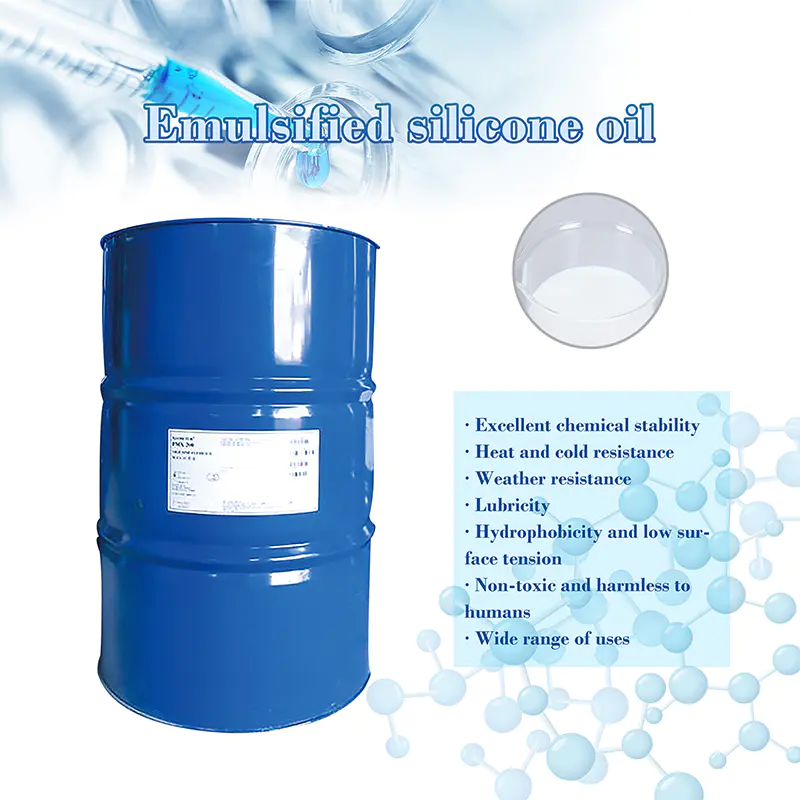
In the field of modern industrial chemistry, emulsified silicone oil serves as a high-performance additive, widely utilized in textile finishing, personal care, mold release lubrication, and coating additives due to its exceptional chemical inertness, superior thermal stability, and extremely low surface tension. Understanding the micro-mechanisms of silicone oil emulsification is critical for improving the performance and stability of the final products.
Micro-structure and Emulsification Mechanism of Emulsified Silicone
emulsified silicone is essentially a thermodynamically stable dispersion system formed by polydimethylsiloxane (PDMS) in an aqueous phase using emulsifiers. Because silicone oil possesses strong hydrophobicity, surfactants must be used to reduce the interfacial tension between the oil and the water phases.
During the silicone oil emulsification process, emulsifier molecules align directionally on the surface of the silicone oil droplets, with lipophilic groups embedded in the silicone oil and hydrophilic groups pointing toward the aqueous phase. This structure effectively prevents the coalescence of silicone oil droplets. In industrial production, common emulsification methods include mechanical shearing and phase inversion. Processing through high-pressure homogenizers allows droplet sizes to be controlled in the nanometer range, which directly determines the light transmittance, adhesion, and permeability of emulsified silicone oil on treated substrates.
Technical Parameter Comparison: Performance Indicators of Different Silicone Emulsions
To meet the needs of different industrial environments, emulsion formulation design requires strict control of technical parameters. The following data reflects the physical constant comparison of emulsified silicone oil with different concentrations under typical processes:
| Parameter Index | 30% Content Silicone Emulsion | 60% Content Silicone Emulsion | Test Standard |
| Appearance | Milky white liquid | Milky white viscous liquid | Visual inspection |
| pH Value | 6.5 - 7.5 | 6.0 - 7.0 | ISO 4316 |
| Average Particle Size | < 0.5 μm | < 1.0 μm | Laser diffraction analysis |
| Stability (3000rpm/15min) | No layering | No layering | Centrifugation test |
| Viscosity (25℃, mPa.s) | 50 - 200 | 500 - 2000 | Rotational viscometer |
Core Elements Affecting the Stability of Emulsified Silicone Emulsions
The long-term storage stability of emulsified silicone is influenced by various factors, with charge stability and preservative systems being the core control points.
Uniformity of particle size distribution: Excessive or uneven particle sizes are the main causes of layering in emulsified silicone oil. Employing high-energy dispersion technology to ensure that silicone oil droplets exhibit Brownian motion significantly increases the shelf life of the product.
Emulsifier compounding technology: Single-component emulsifiers are often difficult to balance for both emulsion stability and shear resistance. Scientific compounding of non-ionic and cationic emulsifiers allows for the construction of a denser interfacial film, maintaining the integrity of the silicone oil emulsification system in high-temperature or extreme cold environments.
Electrolyte tolerance: In some industrial production processes, small amounts of metal ions or acid/base electrolytes may be introduced into the system. Quality emulsified silicone oil formulations incorporate spatial hindrance effects to effectively avoid electrolyte interference with the charge balance of the interfacial film, preventing emulsion breaking.
Efficient Application Guide: How to Improve Treatment Effectiveness
In specific applications, selecting the appropriate emulsified silicone oil for different substrate materials requires consideration of its active ingredients and dilution ratios.
When used for fiber finishing, emulsified silicone provides fabrics with a superior feel. It is recommended that users soften the water before preparing the bath, as high water hardness may react with emulsifiers, affecting the stability of silicone oil emulsification. During stirring, avoid vigorous high-speed agitation to prevent the introduction of excessive air, which leads to foaming of the emulsion.
Furthermore, in mold release applications involving high temperatures, it is necessary to select emulsified silicone products with high thermal degradation temperatures and excellent film-forming properties to ensure the formation of a uniform lubricating isolation film on the mold surface at high temperatures, thereby reducing the defect rate.

Contact Information
Tel : +86-400-138-5268
Email : [email protected]
Phone : +86-15128434888 / +86-13511051998
Add : Xinqiao Environmental Protection Industrial Park, Wen'an County, Langfang City, Hebei Province, China
Contact Information
Copyright © Hebei Guituo New Material Co., Ltd. All Rights Reserved.
