

 English
  Français
  Português
 Home / News / Industry News / Which is Better for Your Products: Emulsified Silicone Oil or Traditional Silicone Oil
 Which is Better for Your Products: Emulsified Silicone Oil or Traditional Silicone Oil
2026-04-13
Advantages of Emulsified Silicone Oil
1. Improved Stability and Performance in Formulations
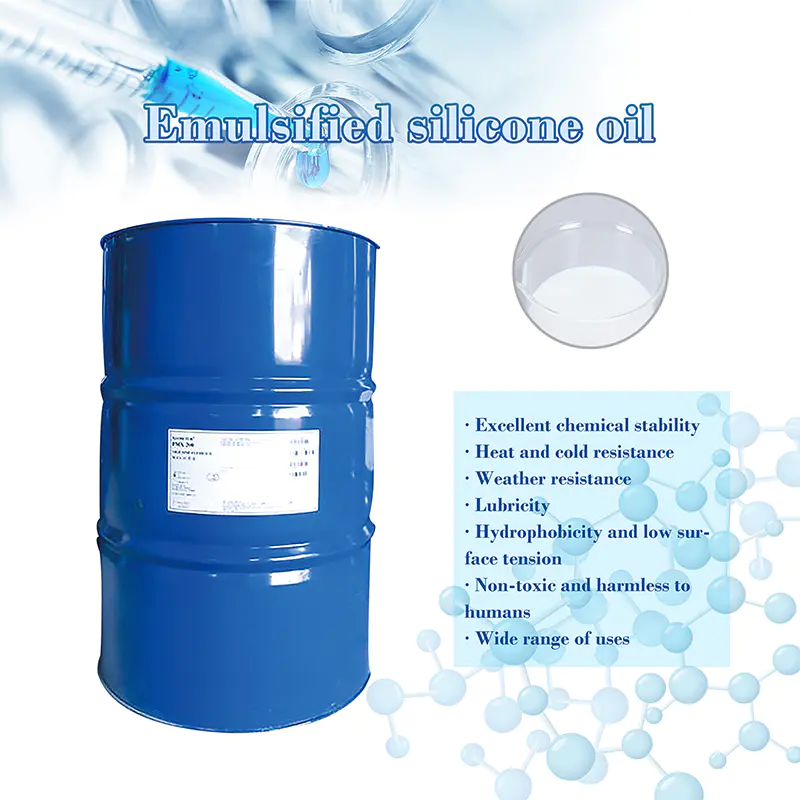
One of the main advantages of emulsified silicone oil is its excellent emulsifying properties. Emulsified silicone oil is created by combining silicone oil with water and stabilizing it through emulsifiers. This allows it to maintain a high level of stability when mixed with other ingredients, preventing issues like separation and sedimentation that can occur with traditional silicone oil. As a result, emulsified silicone oil is more advantageous than traditional silicone oil in cosmetics, personal care products, and coatings industries.
2. Enhanced Softness for Skin and Hair
Emulsified silicone oil plays a vital role in skin and hair care products. It can penetrate the skin or hair surface more effectively and form a uniform protective layer, improving softness and shine. Traditional silicone oil, on the other hand, typically doesn't mix well with water, leaving an oily film on the surface of the skin, which may feel greasy.
3. Higher Environmental Friendliness
Emulsified silicone oil, due to its use of water as a solvent and fewer chemical additives, is more environmentally friendly than traditional silicone oil. The production and usage of emulsified silicone oil have a lower environmental impact, making it a better option for industries seeking to align with sustainability and environmental regulations.
4. Improved Smoothness and Flow in Coatings
In the coatings industry, emulsified silicone oil offers better surface smoothness and flow characteristics. It distributes evenly in the coating, reducing brush marks and air bubbles, resulting in a more polished, smooth finish. Traditional silicone oil, due to its strong hydrophobicity, often doesn't perform as well in coating applications, leaving uneven coverage.
5. Enhanced Lubrication Properties
Emulsified silicone oil not only provides lubrication but also reduces friction, exhibiting superior wear resistance. Compared to traditional silicone oil, emulsified silicone oil's lubrication effect is finer and more even, which makes it ideal for high-performance lubricants and metalworking fluids.
Disadvantages of Emulsified Silicone Oil
1. Higher Technical Requirements in the Emulsification Process
The production of emulsified silicone oil is more complex than that of traditional silicone oil. It typically requires advanced emulsification equipment and technology. Compared to traditional silicone oil, which is easier to produce, emulsified silicone oil adds additional steps, such as controlling the emulsifier ratio, temperature, and pressure, to ensure effective emulsification and product stability.
2. Higher Cost
Due to the complex production process and the need for high-quality emulsifiers and additives, emulsified silicone oil tends to be more expensive than traditional silicone oil. For industries that require large volumes of silicone oil, the cost advantage of traditional silicone oil remains significant. Therefore, in cost-sensitive applications, traditional silicone oil may still be preferred.
3. Certain Application Limitations
Emulsified silicone oil's performance depends on the formulation and the choice of emulsifiers. Some specialized formulations may not be compatible with emulsified silicone oil. While emulsified silicone oil performs excellently in many areas, it may not be suitable for extreme environments, such as extremely high temperatures or strong acidic or alkaline conditions, where traditional silicone oil is more stable.
4. Dependence on Water Phase
Emulsified silicone oil is water-based, which makes it highly effective in water-based formulations. However, in oil-based formulations, emulsified silicone oil may not perform as effectively as traditional silicone oil. The water phase dependence of emulsified silicone oil limits its use in some oil-based cosmetics, lubricants, and other products.
5. Long-Term Skin Effects Not Fully Understood
Although emulsified silicone oil is widely used in skin care and personal care products, the long-term effects of its use on the skin are not fully understood. Traditional silicone oils have been more thoroughly studied for skin applications. The research on the long-term impacts of emulsified silicone oil is still limited, which may lead some consumers to prefer products with traditional silicone oils.
Choosing Between Emulsified Silicone Oil and Traditional Silicone Oil
1. Based on Product Characteristics
In personal care, skin care, and cosmetic products, emulsified silicone oil is often the better choice due to its superior emulsifying effect and stability. It provides better water-oil balance and enhances the user experience. However, in applications where cost sensitivity is a concern or where high-temperature stability is critical, traditional silicone oil may still be preferred.
2. Based on Application Field
Emulsified silicone oil performs exceptionally well in skin care, hair care, and coatings, especially in products that require prolonged contact with water and skin. Traditional silicone oil, on the other hand, excels in industries like automotive and machinery, where its durability and resistance to extreme temperatures and conditions are necessary.


Contact Information
Tel : +86-400-138-5268
Email : [email protected]
Phone : +86-15128434888 / +86-13511051998
Add : Xinqiao Environmental Protection Industrial Park, Wen'an County, Langfang City, Hebei Province, China
Contact Information
Copyright © Hebei Guituo New Material Co., Ltd. All Rights Reserved.
