

 English
  Français
  Português
 Home / News / Industry News / Why Are Your Miticides Failing? Is It Time to Add Mite-Killing Adjuvants to Your Spray
 Why Are Your Miticides Failing? Is It Time to Add Mite-Killing Adjuvants to Your Spray
2026-03-23
Breaking the Protective Shield: Why Pesticides Alone Fail to Eradicate Mites
In modern plant protection, mites such as red spiders, two-spotted spider mites, and rust ticks are recognized as some of the most difficult pests to manage. Many growers find that even with expensive chemical agents, control effectiveness declines, often leading to a more spray, more mites paradox. This phenomenon is not always due to poor pesticide quality but rather the mites' unique physiological structure, which creates a highly efficient protective shield.
Hydrophobic Epidermis and Micro-Defense Mechanisms
The body surface of a mite is not smooth; it is covered with fine hairs and a dense waxy layer. This structure is highly hydrophobic in physical terms. When a standard aqueous pesticide solution is sprayed onto the mite, the high surface tension of the water causes the droplets to form spheres and roll off rapidly, much like water on a lotus leaf.
This physical isolation prevents pesticide molecules from making direct contact with the mite's epidermal cells. If the agent cannot break through this hydrophobic shield, even the most toxic chemical will fail to enter the mite's body to take effect.
The Webbing Natural Shelter
Most spider mites have the habit of spinning silk webs. They typically congregate on the underside of leaves, using silk to weave a thin but tough defensive net. This web not only deters natural enemies but also acts as an umbrella, blocking the majority of atomized droplets.
Chemical Blockage Rate: Without Mite-Killing Adjuvants, over 60% of conventional spray droplets are blocked outside the silk web.
Survival Space: The micro-environment formed under the web remains relatively dry and hidden, making it difficult for the chemical to penetrate gaps and leaving significant control blind spots.
Pesticide Runoff and Leaf Wetting Bottlenecks
In addition to the mite's own defenses, the thick waxy layer of host plants such as citrus, grapes, and roses presents a major obstacle. If the liquid cannot spread on the leaf, it accumulates at the tips and drips off, leading to massive chemical waste.
Physical Performance Comparison of Conventional Spray vs. Mite-Killing Adjuvants
| Physical Parameter | Pure Water / Standard Liquid | With Mite-Killing Adjuvants | Significance for Control |
| Surface Tension (mN/m) | 70 to 72 | 21 to 26 | Determines if the liquid grips the leaf |
| Contact Angle | 90 to 110 degrees | 0 to 15 degrees | Smaller angle means larger coverage area |
| Leaf Adhesion | Weak (Easy to bounce off) | Extremely Strong (Instant stick) | Reduces waste and improves utilization |
| Penetration Depth | Surface only | Pierces web and epidermal wax | Achieves both contact and systemic kill |
The Vicious Cycle: Accelerating Resistance
Due to these physical barriers, field applications often only eliminate 50% to 70% of the mite population. Survivors under low-concentration chemical pressure easily trigger genetic mutations, leading to drug resistance. If Mite-Killing Adjuvants are not used to achieve a high-ratio initial kill, frequent follow-up sprays only accelerate the evolution of the mites' immune systems.
Deciphering Mite-Killing Adjuvants: From Physical Penetration to Biological Synergy
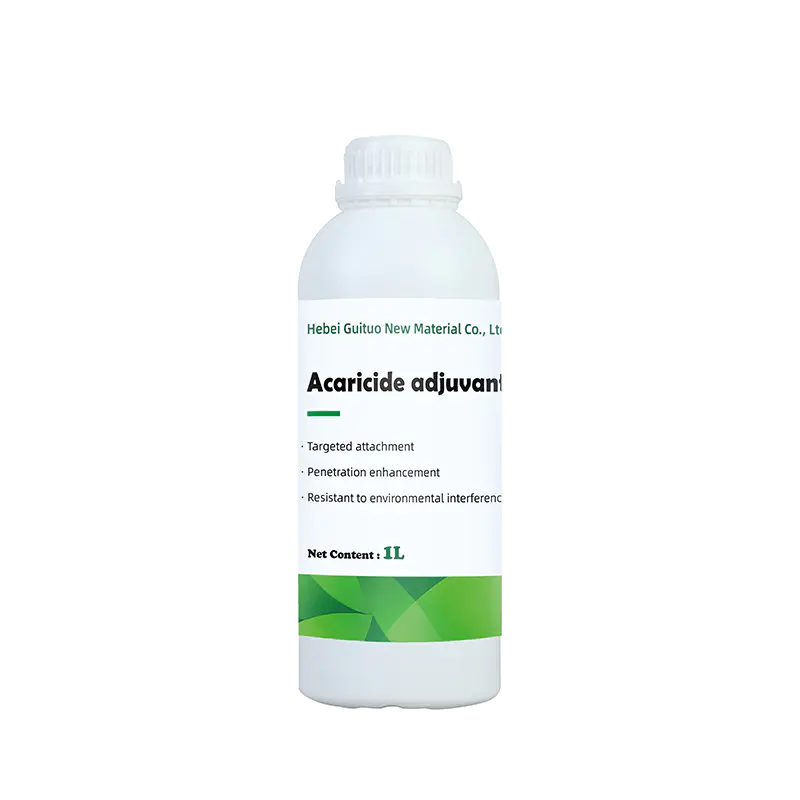
If a miticide is the bullet, then Mite-Killing Adjuvants are the propellant and armor-piercing tip that ensure the bullet hits the target and breaks through the shell. These are high-tech additives designed to fundamentally change the biological activity of the spray liquid.
Core Mechanisms: A Three-Dimensional Attack Mode
Mite-Killing Adjuvants enhance efficacy through three primary dimensions:
Instant Super-spreading: Ordinary droplets remain spherical upon contact. After adding Mite-Killing Adjuvants, the surface tension of the liquid drops below the critical surface tension of the leaf. The droplet expands into a film within seconds, reaching a coverage area more than 10 times larger than the original. This allows the liquid to reach individuals hidden deep in leaf veins through a creeping effect.
Solubilization and Penetration: The waxy layer of a mite's cuticle is lipophilic. High-performance Mite-Killing Adjuvants contain specific lipophilic groups that safely soften this wax. This door-opening action allows chemicals like Abamectin or Etoxazole to penetrate directly into the mite's body or enter the leaf tissue to form a localized chemical reservoir for long-lasting protection.
Anti-evaporation and Film-forming: In dry or windy weather, droplets evaporate quickly. Mite-Killing Adjuvants significantly reduce the evaporation rate and form an ultra-thin physical blockage film on the mite's body. This film locks in the chemical concentration and can block the mite's spiracles, causing death by suffocation.
Quantitative Comparison of Physical Property Changes
| Experimental Index | Pure Water Formulation | With Mite-Killing Adjuvants (0.1%) | Enhancement Logic |
| Surface Tension (mN/m) | 72.0 | 21.5 to 23.8 | Must be below 25 for super-spreading |
| Spread Diameter (mm) | 5 to 8 | 45 to 60 | Coverage increased by 8 to 10 times |
| Droplet Retention (sec) | Less than 30 | More than 120 | Extends liquid state for better absorption |
| Web Penetration Rate (%) | Less than 15% | More than 85% | Ensures liquid passes through defense webs |
| Rainfastness (mm rain) | Less than 5 | 20 to 30 | Improves adhesion against weather |
Main Types and Composition of Mite-Killing Adjuvants
Mite-control adjuvants in global agriculture are divided into four core technological categories, each with different strengths in penetration, spreading, and safety.
Organosilicon Surfactants
The most popular type for extreme spreading, usually based on polyether-modified trisiloxane. It achieves stomatal penetration, allowing the liquid to enter through leaf pores for comprehensive contact. However, it is easily hydrolyzed in strongly acidic or alkaline environments.
Methylated Seed Oils (MSO)
Modified from soybean or rapeseed oil to provide both plant oil affinity and strong solvency. It has the strongest ability among Mite-Killing Adjuvants to break through the mite's epidermal wax. It slows droplet drying in arid conditions but may cause phytotoxicity in very tender crops.
High-Performance Mineral Oils
High-purity aliphatic hydrocarbons that provide both physical and chemical synergy. It forms a breathable but water-impermeable film on the leaf surface and kills mites through physical suffocation by clogging spiracles.
Alcohol Ethoxylates (Non-ionic)
A mild and highly stable type of adjuvant with excellent biodegradability and compatibility. It is extremely safe for crops and performs steadily in hard water or complex tank mixes.
Performance Ratings of Different Adjuvant Types
| Indicator | Organosilicon | MSO | Mineral Oil | Alcohol Ethoxylates |
| Spreading Ability | 5 Stars | 3 Stars | 2 Stars | 4 Stars |
| Penetration (Wax) | 3 Stars | 5 Stars | 4 Stars | 3 Stars |
| Anti-evaporation | 1 Star | 5 Stars | 5 Stars | 2 Stars |
| pH Stability | Poor | Excellent | Excellent | Excellent |
Practical Guide: Selecting Mite-Killing Adjuvants for Different Scenarios
Matching Crop Characteristics
Thick Waxy Leaves: For crops like citrus or apple, use Organosilicon and MSO. Organosilicon spreads into the canopy, while MSO penetrates the thick wax.
Tender Crops: For strawberries or leafy greens, use Alcohol Ethoxylates. These are gentle and minimize the risk of leaf spotting.
Hairy Leaves: For soybean or eggplant, use High-Penetration MSO to ensure the liquid reaches the leaf surface rather than staying trapped on the hairs.
Impact of Environmental Conditions
| Condition | Problem | Recommended Type | Logic |
| High Heat / Dry | Fast evaporation | Mineral Oil or MSO | Protects moisture, extends absorption |
| Rainy Season | Wash-off | Stickers / Polymers | Enhances adhesion and rainfastness |
| Winter / Spring | Dormant eggs | Mineral Oil | Physical suffocation of eggs |
Key Safety and Mixing Reminders
Dilution Rule: Always dilute the pesticide first, then add the Mite-Killing Adjuvant.
Avoid Extreme pH: Organosilicon fails in pH less than 5 or pH greater than 9.
Phytotoxicity Test: Test on a few plants for 48 hours before large-scale application on sensitive varieties.
Scientific Preparation and Application Techniques
The Golden Rule of Mixing
Follow the standard sequence: fill tank 50% to 70% with water, add solid pesticides (WG/WP) and stir, add liquid pesticides (SC/EW), add Mite-Killing Adjuvants last after all agents are uniform, then top off with water.
Quantitative Control of Parameters
| Parameter | High Volume (Conventional) | Low Volume (UAV/Drone) |
| Adjuvant Concentration | 0.05% to 0.1% | 0.5% to 1.0% |
| Dilution Ratio | 1000 to 2000x | 100 to 200x |
| Droplet Size (VMD) | 250 to 400 microns | 150 to 250 microns |
Meteorological Windows
Do not spray if wind exceeds 3 meters per second. Avoid spraying above 32 degrees Celsius to prevent phytotoxicity. Excessive dew in the morning can cause adjuvant-heavy sprays to slide off the leaf.
FAQ: Common Questions and Science Outreach
If my pesticide label says contains enhancers, do I still need Mite-Killing Adjuvants?
Answer: Yes. Formulation adjuvants are for stability and basic wetting. Professional Mite-Killing Adjuvants push surface tension down to 22 mN/m, which is necessary to penetrate silk webs and thick cuticles.
Why does the risk of leaf damage increase with these adjuvants?
Answer: Increased penetration is a double-edged sword. High concentrations can dissolve the plant's own protective wax. Reduce the dose during flowering, fruit set, or extreme heat.
Which adjuvant is best for Red Spiders?
Answer: For active outbreaks, use Organosilicon and MSO. For winter clean-up targeting eggs, use Mineral Oil for its physical suffocation properties.
Can Mite-Killing Adjuvants slow down pesticide resistance?
Answer: Yes. By ensuring a high initial kill rate, fewer survivors are left to mutate. Physical mechanisms like oil suffocation are impossible for mites to evolve genetic resistance against.
How can I easily test the quality of a Mite-Killing Adjuvant?
Answer: Drop the adjuvant onto a waxy leaf like a scallion or citrus leaf. It should instantly creep and spread into a thin film, even wrapping around to the underside of the leaf, whereas pure water would stay in a bead.

Contact Information
Tel : +86-400-138-5268
Email : [email protected]
Phone : +86-15128434888 / +86-13511051998
Add : Xinqiao Environmental Protection Industrial Park, Wen'an County, Langfang City, Hebei Province, China
Contact Information
Copyright © Hebei Guituo New Material Co., Ltd. All Rights Reserved.
