

 English
  Français
  Português
 Home / News / Industry News / Why is your acaricide failing? Is Agricultural Mite-Killing Adjuvants the missing piece
 Why is your acaricide failing? Is Agricultural Mite-Killing Adjuvants the missing piece
2026-02-11
Modern Mite Crises in Agriculture and New Control Strategies
In the cultivation of high-value crops such as citrus, apples, strawberries, and cotton, mites (commonly known as red spiders or white spiders) remain a persistent headache for farmers. Despite the availability of various high-efficiency acaricides, mites are extremely small, reproduce rapidly, and typically aggregate on the undersides of leaves or deep within leaf hairs. These factors make conventional spraying methods struggle to achieve desired control effects.
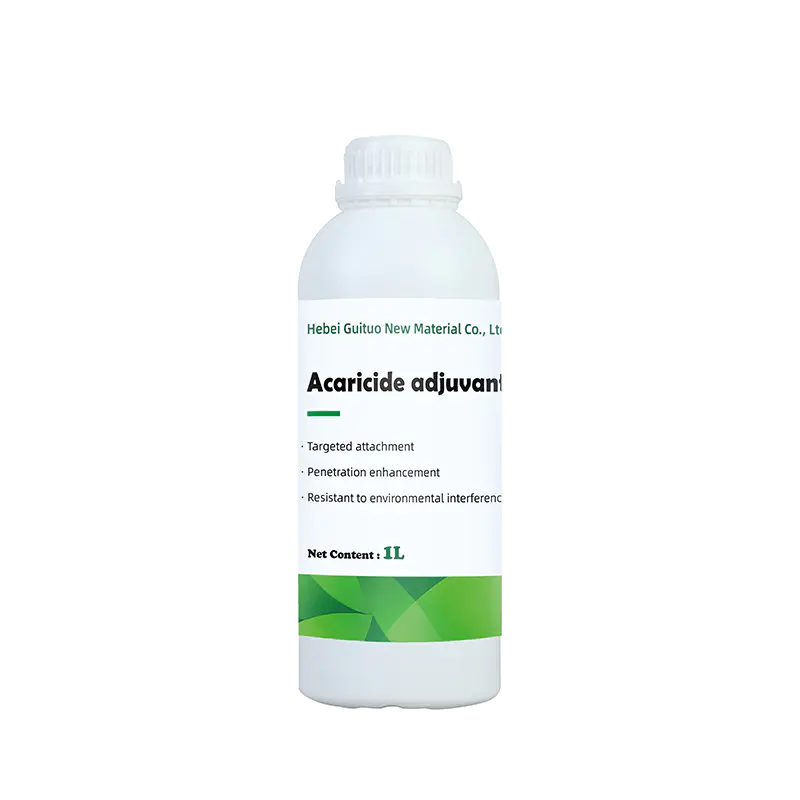
Agricultural Mite-Killing Adjuvants have completely transformed this situation. They are not traditional active pesticide ingredients but rather "efficiency amplifiers" that optimize the performance of the spray solution through physical and chemical means. In addressing the increasingly severe challenge of pesticide resistance, the introduction of Agricultural Mite-Killing Adjuvants has become a core strategy for achieving precision strikes and reducing pesticide use while increasing efficiency.
Core Pain Points and the Intervention Logic of Adjuvants
Physical Barriers: Mites often parasitize the undersides of leaves that have thick waxy layers or dense hairs. Standard aqueous solutions have high surface tension and tend to roll off like water droplets on a lotus leaf.
Pesticide Dead Zones: Traditional spraying techniques find it difficult to penetrate the wrinkled or curled areas of damaged leaves.
Intervention by Agricultural Mite-Killing Adjuvants: By altering the physical properties of the spray droplets, these adjuvants ensure the pesticide can "stick, spread, and penetrate."
Deep Analysis of the Core Mechanisms of Agricultural Mite-Killing Adjuvants
To understand why Agricultural Mite-Killing Adjuvants are the best partners for mite control, one must look at how they transform the physical properties of the spray liquid. The following are the three core synergistic mechanisms:
Breaking Biological Physical Barriers: Super Penetration and Spreading
The surface tension of pure water is approximately 72 mN/m. After adding Agricultural Mite-Killing Adjuvants (especially those containing organosilicon or modified vegetable oil components), the surface tension of the liquid can drop to 20 to 25 mN/m.
Parameter Comparison: Liquid Spread Diameter Test
| Liquid Type | Surface Tension (mN/m) | Expansion Area on Waxy Leaves (Relative Multiplier) |
| Pure Water | 72.0 | 1.0 (Baseline) |
| Conventional Acaricide Suspension | 35.0 - 45.0 | 2.5 - 4.0 |
| Liquid with Agricultural Mite-Killing Adjuvants | 20.5 - 23.0 | 15.0 - 25.0 |
This extremely low surface tension allows droplets to spread instantly upon contact with the leaf, forming an oil-like film that covers the entire surface and even "creeps" to the underside of the leaf through capillary action.
Physical Eradication and Synergistic Enhancement
Adult mites and their eggs possess a protective lipid layer or chitinous shell. Many acaricides (such as Cyetpyrafen or Spirodiclofen) are lipophilic. Agricultural Mite-Killing Adjuvants have an excellent Hydrophilic-Lipophilic Balance (HLB), acting as carriers that pull drug molecules into the mite's spiracles or the interior of the eggshell.
Suffocation Effect: Some adjuvants clog the mite's breathing pores through physical film formation. In addition to carrying the drug, the thin film effectively blocks the tiny spiracles, leading to physical suffocation.
Residual Efficacy: These adjuvants reduce UV degradation and rain wash-off, extending the effective window of the pesticide. Experiments show that adding these adjuvants can shorten the absorption time of systemic acaricides by 30% to 50%.
Rain Wash-off Resistance Parameters:
Experimental Conditions: Simulated rainfall of 20 mm/h one hour after spraying.
Residual Rate Comparison:
Group without adjuvants: Only 15% - 20% of the pesticide remained.
Group with Agricultural Mite-Killing Adjuvants: 65% - 80% of the pesticide remained.
Why Agricultural Mite-Killing Adjuvants are the Best Partner for Mite Control?
In agricultural plant protection, simply having a high-efficiency acaricide molecule is not enough; the key to success lies in delivering these molecules precisely to the target. Agricultural Mite-Killing Adjuvants are considered the best partner because they solve the "last mile" delivery problem in complex biological environments.
Resistance Management: Delaying the Development of Pesticide Resistance
Mites have short life cycles and many generations, making them highly prone to developing resistance. The introduction of Agricultural Mite-Killing Adjuvants assists chemical agents through physical intervention (such as disrupting the waxy layer of the mite's cuticle), making resistant mite populations sensitive to the drugs again.
Synergistic Effect: Trials prove that by adding Agricultural Mite-Killing Adjuvants, the final control effect remains superior to using the pesticide alone, even when the active ingredient dose is reduced by 20% to 30%.
Physical Suffocation: High-concentration adjuvants can directly cover the mite's spiracles; this physical action does not trigger biochemical resistance.
Precision Strikes: Solving the "Backside Blind Spot"
Mites (especially Two-spotted spider mites) are highly photophobic and mostly live in the depressions on the underside of leaves. Conventional spray droplets have uneven size distributions and struggle to adhere to the leaf underside due to gravity. The "zero dead angle" coverage capability of Agricultural Mite-Killing Adjuvants is critical for success.
Coverage Comparison Parameters (Example: Citrus Leaves):
| Evaluation Metric | Traditional Spray (No Adjuvant) | Spray + Agricultural Mite-Killing Adjuvants |
| Upper Leaf Coverage | 65% - 75% | 95% - 98% |
| Under Leaf Coverage | 10% - 25% | 70% - 85% |
| Droplet Uniformity (VMD) | High dispersion, easy to lose | Concentrated size, easy to adhere |
Application Guide for Agricultural Mite-Killing Adjuvants Across Different Crops
Fruit Trees (Citrus, Apple, Grape)
Fruit tree leaves typically have thick cuticles or waxy layers.
Application Focus: Strengthening penetration. The Agricultural Mite-Killing Adjuvants must be able to penetrate thick wax layers to carry the pesticide into the dense interior of the tree canopy.
Recommended Solution: Choose modified vegetable oil-based or organosilicon composite adjuvants with high penetration coefficients to overcome the barrier of high-density foliage.
Field Crops (Cotton, Corn, Peanut)
How to use Agricultural Mite-Killing Adjuvants to reduce drift and improve sedimentation in large-scale spraying.
Application Focus: Anti-drift and deposition.
Parameter Performance: With the use of Agricultural Mite-Killing Adjuvants, the average sedimentation speed of droplets can increase by over 15%, significantly reducing losses caused by wind drift.
Facility Vegetables (Pepper, Strawberry, Eggplant)
Safety considerations: How to avoid phytotoxicity and ensure residue compliance in enclosed environments.
Application Focus: Safety and wetting.
Technical Requirements: These crops have high safety requirements for Agricultural Mite-Killing Adjuvants. It is essential to ensure that while increasing wettability, no damage occurs (such as heart leaf burning or leaf deformity).
How to Select and Use High-Quality Agricultural Mite-Killing Adjuvants
Key Selection Criteria: The Three-Step Method
Compatibility Test: Simulate the mixing concentration in a transparent container to observe if the adjuvant and acaricide (SC, EC, WDG) result in precipitation or oil-water separation.
Expansion Test: Drop the diluted solution onto highly waxy leaves (such as green onions or citrus) and observe the expansion area within 30 seconds.
Safety Verification: Conduct high-concentration tests in a small area to ensure no phytotoxicity occurs, preventing leaf burn under high temperature or high humidity.
Spraying Technique Key Points
Secondary Dilution Method: Ensure that the Agricultural Mite-Killing Adjuvants are thoroughly mixed with the acaricide.
Spray Pressure and Angle: Optimize the spray particle size in coordination with the adjuvant's performance.
Core Parameter Comparison: Performance of Different Adjuvant Types
| Adjuvant Type | Penetration Ability | Spreading Performance | Safety (Young Leaves) | Primary Scenarios |
| Organosilicon | Extremely Strong | Excellent | Medium (Heat may burn) | Outbreak emergency, field crops |
| Mineral Oil | Strong | Average | Lower (May cause oil spots) | Winter cleaning, egg control |
| Vegetable Oil | Medium | Good | Extremely High | Vegetables, young fruit, green ag |
| Agricultural Mite-Killing Adjuvants (Composite) | Optimized Balance | Superior | High | Full cycle, resistant mites |
Integrated Pest Management (IPM) and Mite-Killing Adjuvants
Biological Control Synergy
Using highly selective Agricultural Mite-Killing Adjuvants allows for precision strikes on pests while reducing toxic impact on beneficial insects like predatory mites. High-quality adjuvants can accelerate pesticide degradation or keep it localized on the leaf surface, minimizing harm to beneficial insects living in deeper layers.
Environmental Friendliness and Dose Reduction
Promoting biodegradable and low-toxicity Agricultural Mite-Killing Adjuvants is essential. A core goal is to reduce the total amount of chemical pesticides used.
Dose Reduction and Efficiency Comparison Parameters:
| Indicator | Pesticide Alone (Standard Dose) | Reduced Dose (30% less) + Agricultural Mite-Killing Adjuvants |
| Field Efficacy (7 days) | 82.5% | 91.8% |
| Droplet Drift Rate | High (Wind sensitive) | Significantly Reduced |
| Environmental Pressure | High (Runoff/Leaching) | Minimal (High Adhesion) |
FAQ:
Q1: Can Agricultural Mite-Killing Adjuvants actually kill mites directly?
Answer: While their main purpose is to assist penetration, high-quality Agricultural Mite-Killing Adjuvants (such as specific ratios of organosilicon or oils) have a physical suffocation effect. They form a micron-level film that wraps around the mite's spiracles. For active adult mites, this physical blocking significantly increases the instant mortality rate.
Q2: Does adding adjuvants lead to crop phytotoxicity (leaf burn)?
Answer: This depends on concentration and environment. Phytotoxicity often stems from rapid evaporation of the liquid in high-temperature environments, leading to high local concentrations. When using Agricultural Mite-Killing Adjuvants, follow the recommended dilution (usually 1:1000 to 2000). Avoid application when temperatures exceed 30 Celsius; spraying in the early morning or evening is recommended.
Q3: Why can't I kill red spiders even with the best acaricide?
Answer: Usually, it is not that the pesticide is ineffective, but that it didn't hit the target. Red spiders hide in the hairs on the underside of the leaf. This is why Agricultural Mite-Killing Adjuvants are necessary—they break the barrier and allow the medicine to "crawl" into every crevice and leaf back, achieving zero dead angle coverage.
Q4: Can these adjuvants be mixed with any pesticide?
Answer: In most cases, yes, but strongly acidic or alkaline environments may damage the molecular structure of the adjuvant. It is recommended to perform a "jar test" before mixing to check for precipitation or layering.
Q5: Is there a difference in adjuvant requirements for killing eggs vs. adults?
Answer: Mite eggs have thick, protective shells. To kill them, you must use Agricultural Mite-Killing Adjuvants with strong penetration to help the ovicide (like Etoxazole) penetrate the eggshell barrier. Killing adults relies more on spreading performance to ensure contact with active individuals, thereby achieving "one spray, dual effect."
Q6: Will Agricultural Mite-Killing Adjuvants affect the pesticide residue testing of export products?
Answer: Most Agricultural Mite-Killing Adjuvants are not listed as controlled pesticides. Furthermore, they improve pesticide utilization, which actually reduces the risk of exceeding residue limits caused by frequent spraying. They are a powerful tool for supporting green agriculture and passing residue tests.

Contact Information
Tel : +86-400-138-5268
Email : [email protected]
Phone : +86-15128434888 / +86-13511051998
Add : Xinqiao Environmental Protection Industrial Park, Wen'an County, Langfang City, Hebei Province, China
Contact Information
Copyright © Hebei Guituo New Material Co., Ltd. All Rights Reserved.
