

 English
 Français
 Português

 Home / News / Industry News / Most Commonly Recommended Adjuvant for Pesticides: Nonionic Surfactants & More
Most Commonly Recommended Adjuvant for Pesticides: Nonionic Surfactants & More
2026-10-19
A grower in the southwestern corn belt walks a soybean field ten days after a post-emergence spray pass. A strip of waterhemp near the fence line is still green. The spray rig was calibrated, the glyphosate rate was correct, and the weather was dry. The problem, as many agronomists would diagnose it, is that droplets beaded up on the waxy leaf surface and never absorbed into the plant tissue. The most commonly recommended pesticide adjuvant for this scenario is a nonionic surfactant. In a growing number of cases, the more precise recommendation is an organosilicone-based nonionic surfactant, especially when the weed has a heavy cuticle, the water is hard, or the spray volume is low. This article explains why that recommendation is repeated on so many herbicide labels, when a plain nonionic surfactant is not enough, and how to pair the correct adjuvant with water quality, application equipment, and the crop protection product you are using.
Rooting the choice in the actual mechanism helps. Adjuvants change the behavior of spray droplets: they reduce surface tension, stabilize emulsions, adjust pH, condition hard-water cations, and change how quickly a herbicide penetrates leaf cuticles. Because no single chemistry can do all of those jobs perfectly, the decision becomes a short list of trade-offs. The following sections walk through those trade-offs from a formulation and field performance perspective, using the same logic that adjuvant manufacturers and experienced applicators apply.
Adjuvants in Two Broad Categories
Before comparing individual products, it helps to see the two functional groups that every spray adjuvant falls into. Activator adjuvants increase the biological activity of the pesticide itself. Utility adjuvants, sometimes called special-purpose adjuvants, improve the spray solution, the application process, or the safety of the mix.
Activator Adjuvants
Designed to boost pesticide performance by improving droplet spreading, penetration, or uptake. The most common activator adjuvants are nonionic surfactants, crop oil concentrates, methylated seed oils, and nitrogen-based fertilizer adjuvants such as ammonium sulfate.
Utility Adjuvants
Designed to modify the physical behavior of the spray mixture. This group includes drift control agents, defoamers, deposition agents, water conditioners, compatibility agents, and buffering or acidifying products.
Combination Products
Many commercial adjuvants blend an activator with a water conditioner or a drift control polymer. These all-in-one products are convenient, but they need to be checked against the pesticide label rate and spray volume.
Labeled Adjuvant Type
Most modern pesticide labels specify the exact adjuvant family rather than a single brand. If the label says “nonionic surfactant,” a product from that category will work, but the quality and active content can vary widely between brands.
The distinction matters because the most commonly recommended pesticide adjuvant is not a single molecule. It is a class of chemistry. Within the activator group, the class that appears most often on labels and university recommendations is the nonionic surfactant family. Understanding why that family leads the market requires a closer look at ionic charge.
Why Nonionic Surfactants Dominate Pesticide Recommendations
Surfactants are amphiphilic molecules: one end dissolves in water and the other end dissolves in oils, waxes, or other non-polar materials. There are four main types based on the charge of the water-soluble head: anionic, cationic, amphoteric, and nonionic. Nonionic surfactants carry no electrical charge, which gives them a critical advantage in a pesticide tank.
Most pesticide active ingredients are either weak acids, weak bases, or neutral molecules that can interact with charged surfactants. An anionic surfactant plus a positively charged herbicide can form insoluble salts that drop out of suspension. Cationic surfactants can cause flocculation with commonly used anionic emulsifiers in emulsifiable concentrates. Nonionic surfactants, by contrast, do not react electrostatically with the active ingredient, so they remain compatible across a wide range of products and water chemistries. That compatibility is the central reason why nonionic surfactants are the default recommendation on most herbicide labels, and why they are the most common pesticide adjuvant recommended by agronomists.
| Surfactant Type | Charge | Typical Compatibility Risk | Common Agricultural Use |
|---|---|---|---|
| Anionic | Negative | May form precipitates with cationic pesticides or hard-water metal ions | Wetting agents, emulsifiers, dispersants |
| Cationic | Positive | React with anionic emulsifiers and many weak-acid herbicides | Limited in pesticides; more common in industrial applications |
| Amphoteric | Dependent on pH | Charge changes in solution, creating unpredictable interactions | Occasionally used in cleaners, rarely in crop protection |
| Nonionic | No charge | Minimal electrostatic interaction with pesticides or salts | Most common adjuvant for boosting spreading and wetting |
Nonionic surfactants also perform well in moderate hard water. Because they do not ionize, they do not bind to calcium or magnesium ions in the carrier water. That behavior keeps the surfactant available at the leaf surface rather than tied up in a reaction with dissolved minerals. For more severe hardness, however, even a nonionic surfactant cannot solve the problem alone; the grower must condition the water separately with ammonium sulfate or a dedicated water conditioner.
The word “nonionic” covers several chemical families, including alcohol ethoxylates, alkyl phenol ethoxylates, and trisiloxane alkoxylates. The latter group, commonly called organosilicone surfactants, is a specialized subclass of nonionic chemistry that has become the most widely recommended option for difficult-to-wet leaves and low-volume sprays. The rest of this article separates those two because their field performance differs substantially.
For a deeper look at how these categories perform in real field conditions, see our industry note on how agricultural spray adjuvants work. That overview covers the exact physical mechanisms behind spreading, penetration, and drift reduction.
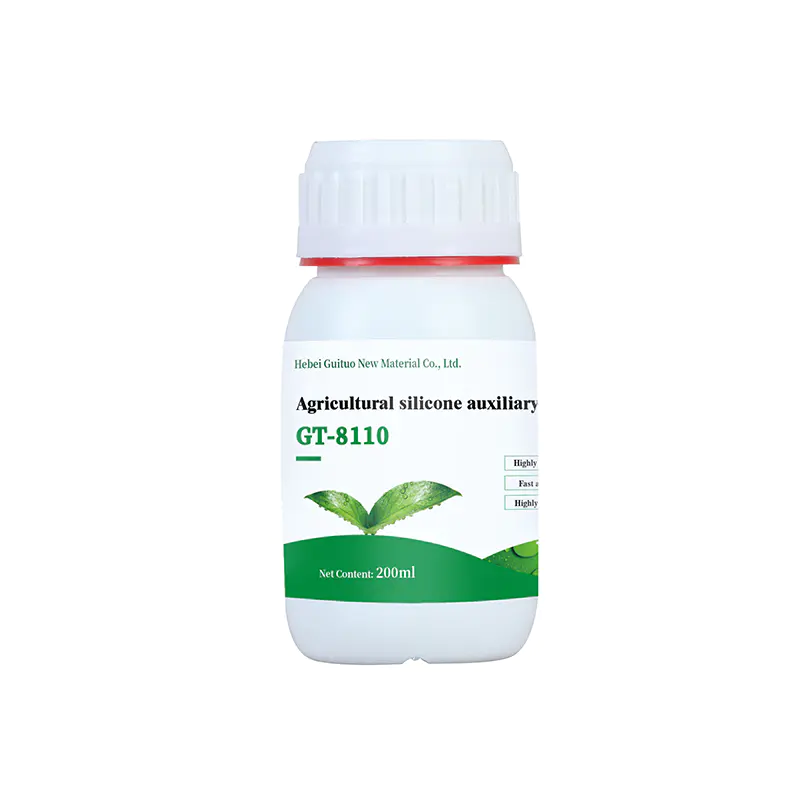
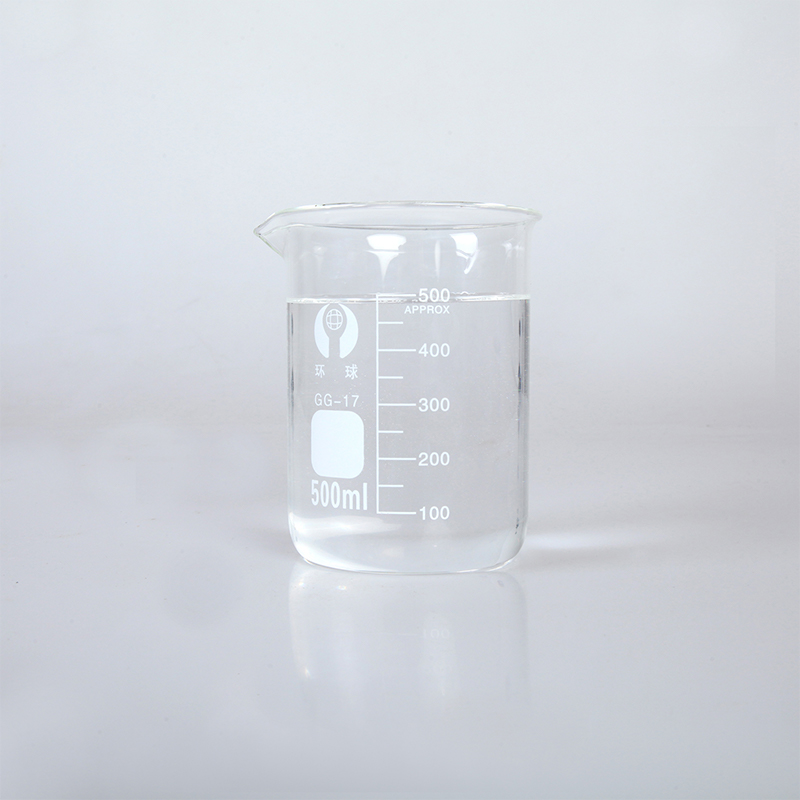 Organosilicone Surfactant for Enhanced WettingThis surfactant lowers surface tension dramatically, improving droplet spread and penetration on waxy leaves, making it a key additive for tough-to-wet crops.View Product →
Organosilicone Surfactants vs Standard Nonionic Surfactants
Standard nonionic surfactants reduce the surface tension of water from about 72 millinewtons per meter (mN/m) down to roughly 35–40 mN/m. That is enough to improve wetting on many broadleaf leaves. But leaves with a thick waxy bloom, such as cabbage, onion, or certain grass weeds, still repel droplets at 35 mN/m. Organosilicone surfactants take the surface tension much lower, often to 20–25 mN/m, which allows the droplet to spread over a much larger area and enter the stomata or cuticle more readily.
This difference explains why crop protection specialists frequently recommend an organosilicone-based nonionic surfactant for herbicides that specifically target waxy or pubescent weeds. It is also the reason aerial application and drone spraying rely so heavily on this chemistry: with small droplets and high evaporation risk, the droplet must spread quickly on contact.
Surface Tension Values for Common Adjuvant Chemistries
The lower surface tension dramatically increases droplet coverage. A 300-micron droplet of water on a paraffin surface may cover a circle of about 2 square millimeters. The same droplet with an organosilicone surfactant can spread over 10 square millimeters or more, depending on the active ingredient concentration. That means more leaf area is covered with the same spray volume, which is why organosilicone products are a common addition to post-emergence herbicides and foliar fertilizers.
There is a catch: faster penetration can also increase the risk of crop injury if the pesticide is not fully selective, and organosilicone surfactants are generally more phytotoxic to sensitive crops at high rates. Label instructions for organosilicone adjuvants typically recommend 0.025% to 0.1% v/v, whereas standard nonionic surfactants are used at 0.25% to 0.5% v/v. Those rates are not interchangeable. A grower who replaces a standard NIS with organosilicone at the same rate may damage the crop.
In practice, the most robust program uses a standard nonionic surfactant for routine broadleaf and grass control, and switches to an organosilicone-based product only when the label calls for it, when the weed spectrum is especially waxy, or when spray volumes are being reduced for drone or aerial applications. Many commercial products combine the two, using a blend of organosilicone and alcohol ethoxylate to balance spreading power with crop safety.
Herbicide Family Adjuvant Guide
Pesticide labels are the starting point for any recommendation, but a practical field guide helps when the label language is too broad. The table below summarizes the adjuvant patterns most commonly seen in modern herbicide recommendations. This is not a substitute for the label, but it reflects the choices made by experienced agronomists and university extension programs.
| Herbicide Family | Typical Active Ingredients | Most Commonly Recommended Adjuvant | Notes |
|---|---|---|---|
| Glyphosate (EPSP inhibitors) | Glyphosate salts | Nonionic surfactant + ammonium sulfate, or ammonium sulfate alone if formulation already contains surfactant | Hard water cations reduce efficacy; AMS is often essential |
| Sulfonylureas (ALS inhibitors) | Chlorimuron, nicosulfuron, thifensulfuron | Nonionic surfactant or crop oil concentrate | Add AMS in hard water to improve foliar uptake |
| Phenoxy acids | 2,4-D, MCPA, dicamba | Nonionic surfactant or high-load MSO | pH and water hardness influence effectiveness |
| Contact grass herbicides | Paraquat, glufosinate | Crop oil concentrate or methylated seed oil | Need rapid burn-down; oils improve cuticle penetration |
| Lipophilic herbicide co-formulations | Many pre-mix products | Crop oil concentrate or MSO when label allows | Oil-based adjuvants help with fat-soluble active ingredients |
The patterns show that the “most commonly recommended adjuvant” depends heavily on the herbicide chemistry. Nonionic surfactants win the overall frequency because they appear on a huge number of glyphosate, glufosinate, and ALS inhibitor labels. But crop oil concentrates and methylated seed oils still have a significant share in contact and lipophilic products. For most modern post-emergence herbicide programs, the pairing is either NIS + AMS or COC/MSO + AMS.
Water Quality, pH, and Ammonium Sulfate
Carrier water quality is often the hidden variable that makes a well-recommended adjuvant fail in the field. Hard water contains calcium, magnesium, and sometimes iron or zinc ions. These cations can displace the weak-acid herbicide molecule from its salt form, creating a less soluble complex that does not cross the leaf cuticle efficiently. The most common fix is ammonium sulfate.
AMS acts as a water conditioner by providing ammonium ions that compete with calcium and magnesium for binding sites on the herbicide molecule. It also helps some herbicides penetrate the cuticle by changing the ionic environment at the leaf surface. University recommendations typically range from 8.5 to 17 pounds of AMS per 100 gallons of water, equivalent to 1% to 2% w/v adjusted for actual ammonium sulfate content. The exact rate should be based on water hardness: the higher the cation concentration, the more AMS is needed.
pH is a second water factor. Many weak-acid herbicides, such as dicamba and 2,4-D, are absorbed more readily in slightly acidic spray solutions. A pH of 4 to 6 helps keep the acid form of the molecule from dissociating too quickly. If the carrier water has a pH above 7.5, an acidifying or buffering adjuvant may be necessary. Conversely, some sulfonylurea herbicides degrade quickly in acidic water, so a buffering agent that raises pH may be recommended. The label usually states the target pH range.
When the water is hard and the pH is high, the order of addition matters. Most protocols recommend adding a water conditioner or AMS first, then buffering agents, then the pesticide, and finally the activator surfactant. This order avoids creating a high-pH environment around the active ingredient before it is fully dissolved.
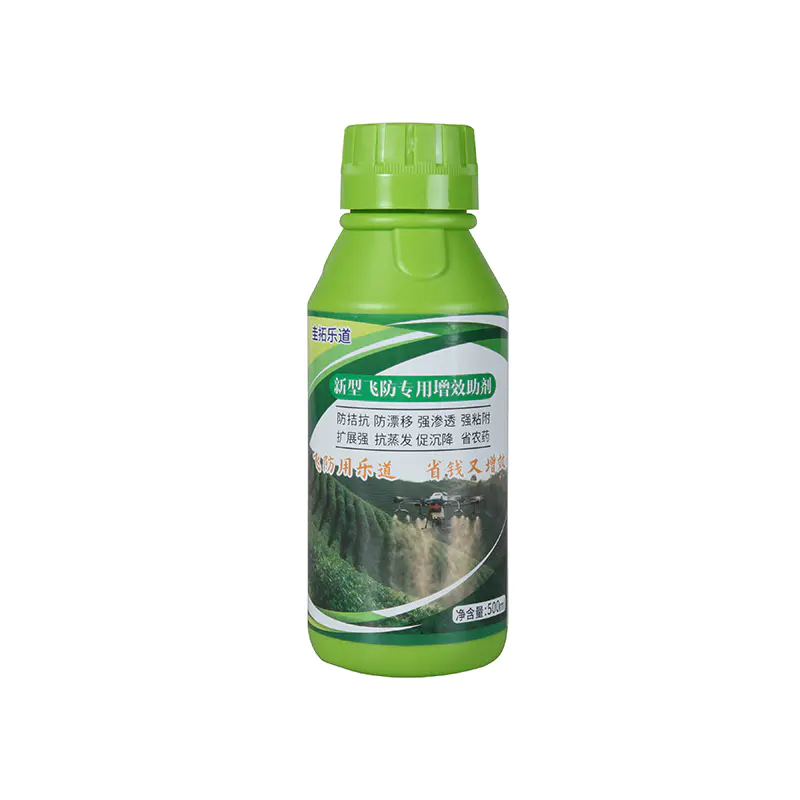
 Aerial Spraying Adjuvant for Drone ApplicationsDesigned for low-volume drone spraying, this adjuvant reduces evaporation and drift while boosting droplet adhesion and pesticide utilization by up to 50%.View Product →
Drones, Aerial Spraying, and Low-Volume Applications
Low-volume application methods have changed how adjuvants are judged. A conventional ground sprayer may use 10 to 20 gallons of water per acre. Aerial applicators can apply herbicide in 2 to 5 gallons per acre, and agricultural drones often operate at 1 to 3 gallons per acre. With that little carrier volume, every droplet must work much harder. Droplet size is smaller, evaporation is faster, and the risk of drift increases.
In this environment, the most commonly recommended pesticide adjuvant shifts toward organosilicone super-spreaders. The rapid reduction in surface tension gives small droplets enough time to spread on the leaf before the water evaporates. For the same reason, drift control agents are often added to reduce the number of fine droplets that leave the target area.
The selection of a dedicated aerial-spraying adjuvant is not just a marketing label. A high-quality aerial adjuvant must maintain very low surface tension at high dilution, remain stable in concentrated tank mixes, and resist foaming. Our aerial spraying enhancement adjuvant is formulated for these conditions, using a blend of trisiloxane ethoxylate and nonionic wetting agents that stay effective at the ultra-low spray volumes used by drones and helicopters.
Applicators who use drones should also reconsider adjuvant rates. A rate measured as “0.1% v/v” means the same proportional concentration regardless of spray volume, but the total product used per acre is much smaller. That can make measuring errors more consequential. Using a graduated cylinder and a correctly sized induction tank helps. A carrier volume of 2 gallons per acre with 0.1% v/v organosilicone requires only about 0.03 gallons of adjuvant per acre, so precise metering is essential.
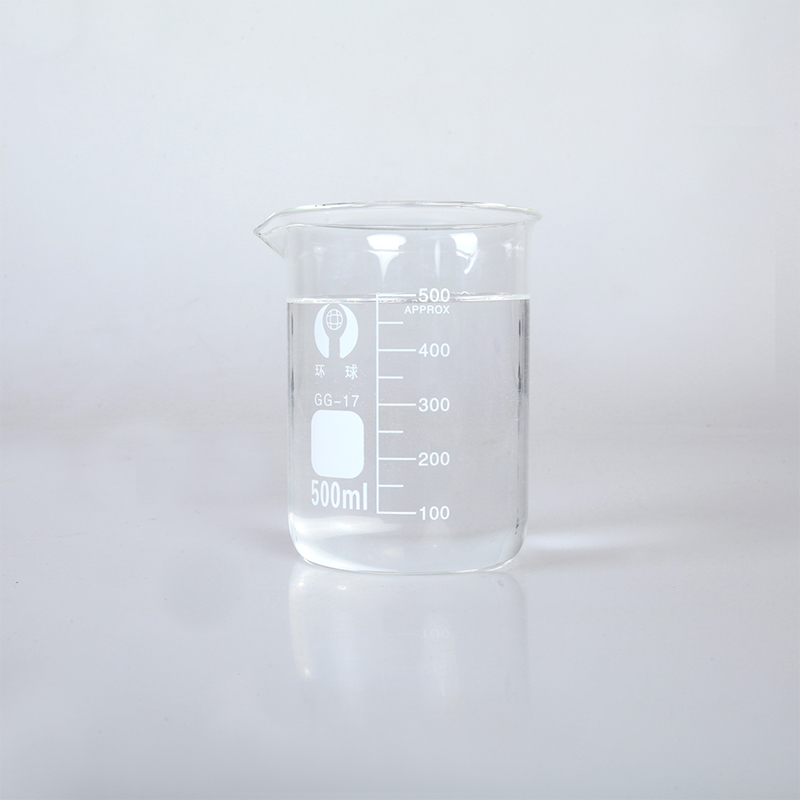 High-Performance Tank-Mix Adjuvant for Pesticide CompatibilityThis drum-mix adjuvant improves compatibility with various pesticide formulations, enhancing adhesion and deposition while reducing drift and evaporation in the tank.View Product →
Tank Mixing Order and Jar Test Protocol
Even the correct adjuvant will fail if the tank mix is physically incompatible. Some pesticides are wettable powders, some are suspension concentrates, and some are emulsifiable concentrates. Each formulation has its own charge, surface chemistry, and suspending behavior. The sequence in which they are added can determine whether a stable emulsion forms or whether the tank turns into a sticky sludge.
A widely used jar test procedure can predict most compatibility issues with simple equipment. A quart jar, a measuring spoon, and the actual carrier water are enough for a preliminary check. The goal is to see if the mixture stays uniform for at least 30 minutes without visible clumping, oil separation, gel formation, or excessive settling.
- Fill a clean quart jar about three quarters full with the same water that will be used in the field.
- Add the water conditioner or ammonium sulfate first, and shake gently.
- Add compatibility agents, if needed, and mix.
- Add wettable powders slowly while swirling, followed by suspension concentrates and emulsifiable concentrates.
- Add the pesticide active ingredients in the order listed on the label.
- Add the surfactant or crop oil last, then shake the jar with a swirl action to avoid excessive foaming.
- Let the mixture stand for 15 to 30 minutes and inspect for separated layers, floating oil, or gritty particles.
- If the mixture fails, test a different addition order or use a compatibility agent. A simple jar test can save an entire day of field work.
The sequence above reflects the general principle that electrolytes and water conditioners enter the tank first, followed by products that need thorough dispersion, and finally the surface-active materials that stabilize the mixture. Putting a surfactant in first can foam excessively and make subsequent mixing difficult.
High-performance tank-mix adjuvants, such as our drum-mix adjuvant, are designed to be compatible with a wide range of pesticides and spray modifiers. They usually contain a nonionic surfactant, a water conditioning component, and a defoamer in one package. That built-in compatibility reduces the number of mixing steps but does not eliminate the need for a jar test with new crop protection products.
Buying from an Adjuvant Manufacturer: Key Quality Indicators
When purchasing adjuvants in volume, the choice goes beyond field performance. A buyer needs to know what is actually inside the drum and whether the product will remain stable through storage, freezing, and long-distance transport. As a manufacturer of agricultural silicone additives, we evaluate products on a specific set of quality indicators that are often absent from consumer-oriented marketing sheets.
Active Content and Dilution
Two products can both be called “nonionic silicone surfactant” yet contain different amounts of active trisiloxane. A product with 50% active content can look significantly cheaper per liter, but the recommended rate must be higher to deliver the same surface tension reduction. Requesting the percentage of active matter and comparing cost per acre rather than cost per liter is a sound procurement practice.
Cloud Point and Temperature Stability
Nonionic surfactants have a cloud point: the temperature at which the surfactant separates from the water and turns the solution cloudy. If the cloud point is below typical spray water temperatures, the surfactant loses wetting power. A high cloud point is generally safer for warm-climate spraying. For organosilicone products, the cloud point is often above 40°C, but it is still worth checking.
Surface Tension and Contact Angle
A quality organosilicone surfactant should reduce pure water surface tension to below 25 mN/m at the recommended field rate, and produce a contact angle lower than 30 degrees on paraffin film within 2 minutes. These laboratory values translate into faster spreading on waxy leaves. Reputable suppliers can provide certified COA data for surface tension, pH, and viscosity.
Custom Formulation and OEM/ODM Options
For distributors or agronomy companies that want their own brand, OEM and ODM production is common in the adjuvant industry. A manufacturer with in-house synthesis and blending capacity can adjust the surfactant system, viscosity, color, or packaging while retaining consistent quality. In our case, Hebei Guituo New Material Co., Ltd. operates its own test laboratory and production facility, and the trading arm in Ningbo handles export documentation and logistics. This setup allows custom formulation work without passing through multiple intermediary companies.
Additional Informational Resource
If you are comparing products directly, a temperature-controlled stability test is a useful in-house check. Place a sample of the adjuvant in a clear bottle and cycle it between freezing and 40°C. Look for phase separation or permanent discoloration after three cycles. This simple screening method can identify low-quality products before they reach a spray tank. For more details on choosing the right agricultural silicone synergist, see our guide on how to choose the right agricultural silicone synergist.
Frequently Asked Questions
What is the single most commonly recommended pesticide adjuvant?
Nonionic surfactants are the most common single category. They are recommended with more herbicides, fungicides, and insecticides than any other adjuvant type because of their compatibility, low risk of crop damage, and reliable wetting activity. When hard water is an issue, nonionic surfactants are usually paired with ammonium sulfate.
Can I use dish soap as a nonionic surfactant substitute?
No. Dish soaps are anionic surfactants and often contain salts, fragrances, and dyes that can damage leaves or react with pesticides. The anionic charge can also bind with weak-acid herbicides and reduce efficacy. A formulated agricultural wetting agent is designed to be compatible with active ingredients and does not leave residues that affect plant growth.
What is the difference between a crop oil concentrate and a nonionic surfactant?
A crop oil concentrate is a blend of petroleum-based oils and emulsifiers that helps fat-soluble pesticides penetrate the waxy cuticle. A nonionic surfactant is water-soluble and primarily reduces surface tension to improve droplet spreading and coverage. Oils tend to work better on hard-to-control grasses and broadleaf weeds under dry conditions; nonionic surfactants are generally safer on sensitive crops and simpler to use at low rates.
How do I calculate adjuvant rate for drone spraying when the label gives a percentage?
Percent by volume (v/v) does not change with carrier volume, but the total product applied per acre becomes very small. For example, 0.1% v/v in 3 gallons of water per acre equals 0.003 gallons of adjuvant per acre, or about 11.4 milliliters. Use a precision measuring container and recalibrate whenever you change spray volume.
Should I always follow the pesticide label recommendation even if a supplier suggests a different adjuvant?
The label is the legal baseline. If the label specifies a nonionic surfactant, using a different type without testing could result in reduced efficacy or crop injury. A supplier can recommend a higher-grade product within the same category, but deviating from the label requires local regulatory approval and careful documentation.
Can I mix organosilicone surfactant with a drift control agent?
Yes, but test compatibility first. Some drift control polymers thicken the spray solution and may reduce the spreading efficiency of the organosilicone. High-shear tank agitation can break down the polymer structure, so add the drift control agent slowly and verify droplet size in a jar test.
Final Selection Checklist for Adjuvants
The choice of the most commonly recommended pesticide adjuvant is rarely a single product for every spray. Use this checklist to make the final decision before mixing.
- Read the pesticide label for the exact adjuvant family and rate. If the label lists a nonionic surfactant, start with that family.
- Test carrier water hardness and pH. If hardness exceeds 300 parts per million of calcium carbonate, plan an ammonium sulfate or dedicated water conditioner.
- Identify the target plant type. Waxy or hairy leaf surfaces call for an organosilicone super-spreader; smooth broadleaf leaves can be managed with a standard nonionic surfactant.
- Consider the spray volume. Low-volume aerial or drone applications require an adjuvant with very low surface tension and quick wetting.
- Run a jar test on any new combination of pesticide, water, and adjuvant, especially when you change product batches or water sources.
- Check the adjuvant’s active content and verified surface tension data, not just the brand name. Quality differences within the same category are large.
- Keep records of the exact adjuvant rate, weather conditions, and spray results. Field history often outperforms a generic recommendation.
- When buying in bulk, ask the manufacturer for COA, stability data, and temperature performance. A reliable supplier should answer those questions with technical documents, not just a sales page.
Nonionic surfactants remain the most commonly recommended pesticide adjuvant because they solve the most frequent field problem: poor droplet wetting on difficult leaf surfaces. Within that group, organosilicone-based formulations handle the hardest cases, from waxy weeds to drone spray volumes. By matching the adjuvant chemistry to the herbicide family, water chemistry, and application equipment, a grower can turn a marginal spray window into a consistent result.

Contact Information
Tel : +86-400-138-5268
Email : [email protected]
Phone : +86-15128434888 / +86-13511051998
Add : Xinqiao Environmental Protection Industrial Park, Wen'an County, Langfang City, Hebei Province, China
Contact Information
Copyright © Hebei Guituo New Material Co., Ltd. All Rights Reserved.
