

 English
  Français
  Português
 Home / News / Industry News / What Are the Two Types of Adjuvants? Activator vs Utility Spray Adjuvant Guide
 What Are the Two Types of Adjuvants? Activator vs Utility Spray Adjuvant Guide
2026-09-07
Every spraying season produces the same conversation at grower meetings and trade-show booths: a pesticide label instructs the applicator to add a nonionic surfactant, the local catalog offers twenty products with different names, and nobody is quite sure which category each product belongs to. The confusion is understandable, because the word adjuvant is an umbrella term that covers chemistries with completely different jobs. Before spending money on another drum, it helps to know that the crop protection industry sorts spray additives into exactly two functional families.
The two types of spray adjuvants are activator adjuvants and special-purpose adjuvants, also called utility adjuvants. Activator adjuvants increase the biological activity of the pesticide itself, which means more active ingredient enters the leaf at the same dose. Utility adjuvants correct the physical and mechanical problems of an application, such as drift, foam, incompatibility, and unstable mixes, so that the spray which leaves the nozzle is still the spray that was planned.
Type 1, activator adjuvants: wetting agents and surfactants, organosilicone super-spreaders, crop oil concentrates, methylated seed oils, and fertilizer-based activators such as ammonium sulfate. Their measure of success is simple: better uptake and better control from the same rate of active ingredient.
Type 2, special-purpose or utility adjuvants: drift-reduction agents, deposition aids, antifoam and defoaming agents, compatibility agents, pH buffers and acidifiers, water conditioners, dyes, and thickeners. Their measure of success is different: the application survives the journey from tank to target without losing volume, stability, or neighbor goodwill.
The rest of this article walks through each type, shows where the boundary between them blurs, and lists the checks a procurement or agronomy team should run before ordering. The goal is practical: by the end, a buyer should be able to look at any product on a shelf and place it in the correct family within seconds.
One Word, Two Different Products: Formulation Adjuvants vs Spray Adjuvants
An adjuvant is any substance added to a pesticide, either built into the formulated product or added to the spray tank separately, that improves performance or handling without itself killing a weed, fungus, or insect. That definition hides an important manufacturing distinction. Formulation adjuvants, such as emulsifiers and stabilizers, are blended into the product by the manufacturer and are invisible to the end user. Spray adjuvants are purchased separately and dosed at the point of application, which puts the mixing decision directly in the hands of the applicator.
The activator versus utility classification applies specifically to spray adjuvants, the products that arrive in jugs and get poured into the tank. The split matters because the two families fail in different ways and are therefore judged by different evidence. An activator fails when weeds regrow after treatment, which is a chemistry problem. A utility adjuvant fails when the tank foams over, the mix gels in the induction hopper, or droplets drift onto a neighboring crop, which is a physics and logistics problem.
For readers who want the underlying mechanics of how these products act on a droplet and a leaf surface, our guide to agricultural spray adjuvants and how they work covers wetting, spreading, and uptake in detail.
Type 1 at a glance
- Goal: push more active ingredient into the target.
- Typical members: surfactants, silicone super-spreaders, crop oils, methylated seed oils, ammonium sulfate.
- Dosing: a small percentage of spray volume, usually added last.
- Failure mode: regrowth, retreatment, wasted chemical.
Type 2 at a glance
- Goal: keep the spray on target and the mix stable.
- Typical members: drift reducers, defoamers, buffers, compatibility agents, dyes, water conditioners.
- Dosing: function-specific, from milliliters per 100 liters up to higher rates for thickeners.
- Failure mode: drift complaints, foam, gelled tanks, clogged filters.
One caution before moving on: a few products sit on both sides of the line. Ammonium sulfate is the classic example, because it conditions hard water, a utility job, while also improving uptake of certain herbicides, an activator job. When a product claims two functions, ask which function the pesticide label actually requires.
Type 1: Activator Adjuvants, the Chemistry Multipliers
Activator adjuvants share one objective: increase the effect of the active ingredient. They work at the moment a droplet lands and during the hours that follow, by lowering surface tension, reshaping the droplet, softening or solubilizing the leaf cuticle, and controlling how fast the spray film dries. Four subfamilies do most of the work in the field.
Surfactants and Wetting Agents
A surfactant molecule has a water-loving head and an oil-loving tail, so it migrates to the surface of the spray droplet and pulls the surface tension of water down from roughly 72 mN/m into the low 30s. Lower surface tension means a smaller contact angle, which means the droplet lies flat on a waxy leaf instead of sitting like a ball and rolling off. For broadleaf weeds with thick cuticles, a wetting agent is often the difference between a droplet that beads and dries into a ring and a droplet that spreads into a film.
Surfactants are grouped by ionic charge into nonionic, anionic, cationic, and amphoteric classes. Nonionic surfactants are the default recommendation for most pesticide mixes because they carry no charge that could react with the formulated product. Typical rates run between 0.1 and 0.5 percent of spray volume, but the pesticide label always wins over any catalog suggestion.
Organosilicone Super-Spreaders
Organosilicone surfactants, based on polyether-modified trisiloxanes, push surface tension far below what conventional nonionics can reach, into the low 20s in mN/m. At that level the contact angle collapses toward zero and the droplet spreads within seconds to many times its original area. On hard-to-wet surfaces the product can move the active ingredient into stomatal channels, so uptake continues even if rain arrives shortly after application. For many super-spreader products, rainfastness is measured in minutes rather than hours, which is why dense canopies, low water volumes, and drone spraying are their natural territory.
Surface tension reached in the spray solution (approximate values)
Typical published values; exact figures shift with concentration, temperature, and water hardness.
The same power creates the classic mistakes. Doses that exceed the label window, which for super-spreaders often sits between 0.025 and 0.1 percent by volume, can push the mix off the leaf entirely, leave less deposit behind, and in humid conditions even flood open stomata, which some plant pathologists link to higher disease pressure on sensitive crops. Silicone super-spreaders reward precision, not generosity.
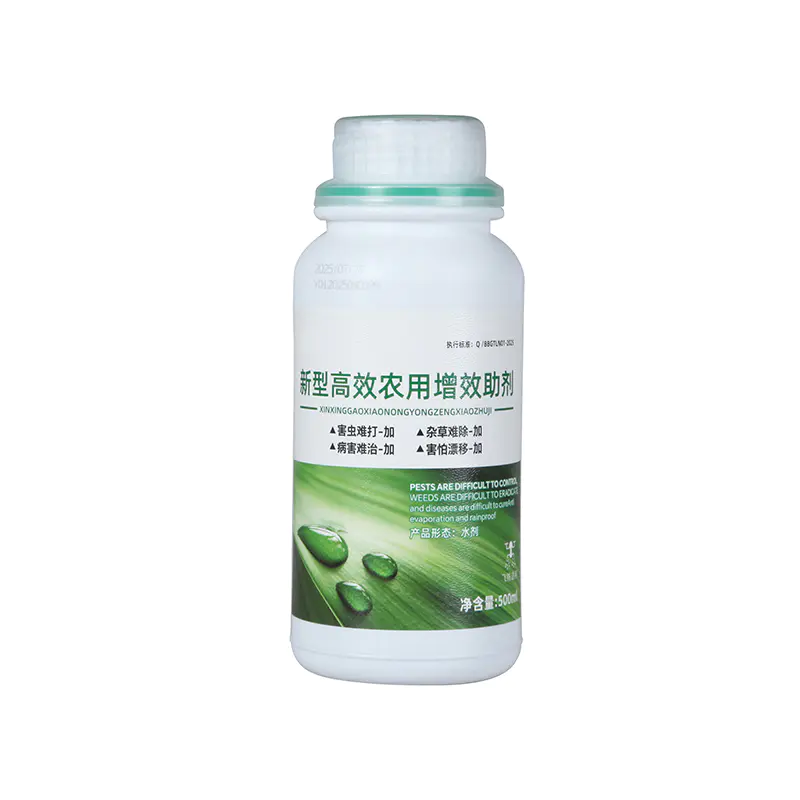
Activator Adjuvant Organosilicone Surfactant Polyether-modified trisiloxane super-spreader that cuts spray solution surface tension into the low 20s in mN/m for fast wetting and uptake on waxy leaf surfaces. View product specificationsOils and Methylated Seed Oils
Crop oil concentrates combine a paraffinic mineral oil with an emulsifier, while methylated seed oils derive from soybean or rapeseed oil. Both work partly by solubilizing the waxy cuticle, giving water-based droplets a path into the leaf. On species with heavy wax layers, methylated seed oils frequently outperform plain nonionic surfactants. The trade-off is aggressiveness: oils can stress the crop under hot, dry conditions, so their rates, usually 0.5 to 1 percent of spray volume, deserve respect.
Fertilizer Salts as Activators
Ammonium sulfate and urea-ammonium nitrate solutions double as activators. Ammonium sulfate has a specific, documented role: calcium and magnesium ions in hard water tie up certain herbicide molecules and reduce uptake, and the sulfate binds those ions first. That is why so many herbicide labels demand ammonium sulfate before any other addition. Typical rates sit around one to two percent of solution weight, adjusted to the measured hardness of the water.
Type 2: Special-Purpose and Utility Adjuvants, the Application Insurance
Utility adjuvants rarely get credit for pest control because they never touch the chemistry. What they do is protect the application from physical failure. Every grower has met one of these failures: foam climbing out of the induction hatch on a windy morning, a mix that turns into mayonnaise in the hopper, droplets that drift two fields over, or an active ingredient that has half-decomposed by the time the tank is empty because the well water sits at pH 9. Each failure has a matching utility product.
| Subtype | What it corrects | When it earns its place |
|---|---|---|
| Drift-reduction agents | Increases average droplet size and cuts the fraction of fines below roughly 150 microns. | Sensitive crops downwind, hot and dry days, drone or low-volume work. |
| Deposition aids | Makes droplets stick and hold on the target instead of bouncing off. | Waxy or vertical leaf surfaces, high travel speeds, angled targets. |
| Antifoam and defoaming agents | Collapses foam produced by surfactants, hard water, and recirculation. | High surfactant loads, vigorous agitation, transfer pumps. |
| Compatibility agents | Keeps two or more products in one tank without sludge, cream, or gel. | Fertilizer plus pesticide combinations, mineral-heavy water. |
| Buffering agents and acidifiers | Holds spray water in a mildly acidic window, commonly pH 5 to 6.5. | Alkaline well water, long spray days, actives prone to alkaline breakdown. |
| Water conditioners | Ties up calcium and magnesium ions that antagonize certain actives. | Hardness above roughly 300 ppm expressed as calcium carbonate. |
| Dyes and foam markers | Shows where the spray has already landed. | Spot work, boundary passes, several sprayers in one field. |
| Humectants | Slows drying so the active stays dissolved and absorbable longer. | Hot weather, very low water volumes, slow-uptake actives. |
Drift Reduction and Deposition Aids
Droplets below roughly 150 microns in diameter slow down almost immediately after leaving the nozzle, hang in the air, and follow the wind. Polymer-based drift reducers raise the viscosity of the spray liquid so the nozzle produces a coarser spectrum with fewer fines. The cost is coverage: fewer, larger droplets hit fewer target sites, so the rate and the nozzle choice have to be balanced together. Deposition aids tackle the other half of the problem by making droplets stick on impact instead of bouncing off waxy leaves.
Antifoam and Defoaming Agents
Foam is the predictable result of surfactants, hard water, and recirculation pumps meeting in one tank. Silicone-based defoamers collapse foam at extremely low doses because their own surface tension is lower than the foam film they land on; the film thins and breaks within seconds, which is faster than most organic polymer alternatives at comparable rates. In practice, the defoamer goes in early, often right after the tank is a quarter full, because adding it on top of a full foam column wastes half of its effect.
Utility Adjuvant, Antifoam Family Organosilicone Defoamer Silicone-based antifoam that collapses surfactant foam within seconds at very low doses, designed to enter the tank early in the filling order. View product specificationsBuffers, Acidifiers and Compatibility Agents
Many active ingredients hydrolyze in alkaline water, which means the molecule decomposes while the tank is still being filled. Buffering agents and acidifiers hold the carrier in a mildly acidic window where most actives remain stable through a long spray day. Compatibility agents solve a different problem: mixes that contain fertilizer solutions, several formulated products, or mineral-heavy water can form precipitates, gels, or creams that plug filters within minutes. A ten-minute jar test with the real water and the real products, following the same order of addition planned for the tank, reveals most of these failures before they cost a day of spraying.
Dyes, Markers and Water Conditioners
Dyes and foam markers leave a visible trace that prevents overlap and missed strips, which sounds trivial until a fleet of sprayers works the same field at dusk. Water conditioners, most commonly ammonium sulfate, sequester the calcium and magnesium ions that interfere with certain actives and destabilize emulsions. Water quality is the most underrated variable in an entire spray program, because it changes chemistry and mixing behavior at the same time.
Activator vs Utility Adjuvants: A Side-by-Side Comparison
The table below condenses the two families into the attributes that matter when choosing between them, or deciding whether a mix needs both at once.
| Aspect | Activator adjuvants | Special-purpose (utility) adjuvants |
|---|---|---|
| Core objective | Boost the biological effect of the active ingredient. | Protect the application process from physical failure. |
| Typical members | Wetting agents, silicone super-spreaders, crop oils, methylated seed oils, ammonium sulfate. | Drift reducers, defoamers, buffers, compatibility agents, dyes, water conditioners. |
| Success measured by | Uptake, control level at the same dose, spread area on the leaf. | Droplet spectrum, foam height, tank stability, volume reaching the target. |
| Usual mixing position | Last, after the pesticide is fully dispersed. | Varies: water conditioners first, defoamers early, drift reducers per label. |
| Main risk if misused | Crop injury, off-target uptake, wasted chemical. | Drift complaints, clogged filters, unstable mixes. |
| Rate logic | Small percentage of spray volume, precise and label-bound. | Function-specific; some at milliliter doses, thickeners at higher rates. |
Two practical notes belong next to this table. First, most commercial adjuvants are blends of several functions, so the name on the drum is marketing while the function list in the technical data sheet is the truth; ask for the data sheet. Second, when a blend claims both families at once, confirm which single function the pesticide label requires, because the label wording is what a regulator or an insurance assessor will read after an incident.
A Working Order of Addition for a Tank That Uses Both Types
Mixing order is where theory meets the farm. Adding products in the wrong sequence causes most incompatibility problems, because each addition changes the surface chemistry of everything already in the water. The sequence below works for the large majority of mixes; the pesticide label overrides it wherever the two disagree.
1 Water and conditioner
Half-fill the tank, start agitation, and add ammonium sulfate first when hardness is known.
2 Defoamer
If the mix has foamed before, add the silicone defoamer now, while the liquid column is still short.
3 Dry formulations
Water-dispersible granules and wettable powders go in next, preferably pre-slurried in a bucket.
4 Suspensions
Suspension concentrates and suspo-emulsions follow, rinsed in slowly while agitation keeps running.
5 Emulsifiables
Oil-based concentrates and soluble liquids join last among the pesticide products.
6 Activators and markers
Surfactant or silicone super-spreader goes in at the end, followed by dye or foam marker.
The logic is simple. Solids must disperse before viscosity rises, oils must emulsify before surface-active agents redefine the whole system, and activators come last because their entire job is to change the surface behavior of the finished liquid. Operators using induction bowls or drone charging buckets compress the same sequence into a smaller container, but the order stays identical.
Where the Two-Type Rule Meets Silicone Chemistry
By classification, organosilicone products belong to the activator family. In practice they change decisions that traditionally belong to the utility side, because a super-spreader lets the applicator cut water volume dramatically, and low-volume spraying moves drift control, droplet survival, and tank stability to the center of attention. The two categories stop being a checklist and become a set of trade-offs.
The numbers explain why. Water at 72 mN/m wets few leaf surfaces well; a conventional nonionic in the low 30s handles most crops; an organosilicone super-spreader in the low 20s spreads across waxy leaves and even into stomatal openings. A single droplet can cover several times, sometimes more than ten times, the area that plain water manages. That is what makes 20 to 30 liters per hectare through a spraying drone feasible where a ground boom would have used a large multiple of that water.
Typical spray volume per hectare by platform (approximate field midpoints)
Actual volumes vary with crop, nozzle selection, water quality, and local regulation.
Low-volume work needs both families at once: an activator to guarantee coverage from a small number of droplets, and utility support to keep those droplets from drifting away before they land. This is why dedicated aerial products combine a super-spreading component with drift-management properties in one formulation, and why drone operators who run plain surfactants often see good coverage but complain about fines appearing downwind.
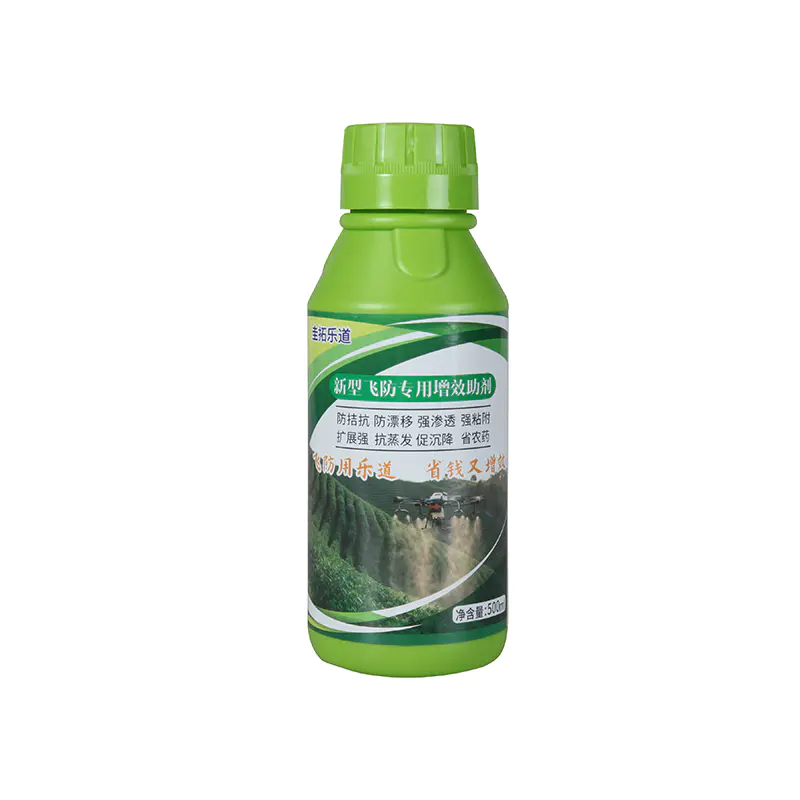
Aerial Application Adjuvant New High-Efficiency Aerial Spraying Enhancing Adjuvant Combines super-spreading performance with drift management for drone and low-volume spraying, where every droplet has to count. View product specificationsThere is also a sourcing angle worth knowing. Polyether-modified silicone oils are the backbone of super-spreading surfactants, and a supplier that manufactures its own silicone raw materials can tune spreading speed, cloud point, and hydrolytic stability for a given crop or water profile, then verify each batch in a laboratory. As a manufacturer of organosilicone surfactants and their silicone intermediates, we see the difference in field results when the raw material is specified and tested rather than bought on the open market.
Five Practical Risks That Show Up After the Purchase
Most adjuvant complaints we hear at exhibitions and from returning customers trace back to one of five avoidable mistakes. Each one costs more than the price difference between a careful product and a careless one.
Treating all surfactants as the same product
Charge class matters. An anionic surfactant can destabilize a mix that a nonionic handles easily, and cationic products are rarely appropriate with pesticides. Ask for the ionic class in writing, not just the word surfactant.
Overdosing super-spreaders
Doubling the rate does not double the effect. Excess silicone surfactant pushes liquid off the leaf, thins the deposit, and can increase disease entry through open stomata. Stay inside the label window.
Skipping the jar test
A clear glass jar, the real water, the real products, and the planned order of addition reveal gels, precipitates, and heat in ten minutes. One skipped test can cost a plugged filter, a wasted tank, and a lost spray window.
Ignoring water quality
Hardness above roughly 300 ppm as calcium carbonate, or pH drifting toward 9, changes both activity and mixing behavior. Condition the water first and the rest of the mix behaves the way the label assumes.
Buying without batch documentation
Adjuvant quality varies between production runs. Request a certificate of analysis for each batch, confirm the declared active content and its tolerance, and check shelf life and storage range before committing.
A drum of adjuvant is a small line item next to the pesticide it supports, which is exactly why it gets bought carelessly. The cheapest product on the shelf and the cheapest failure in the field are usually the same purchase.
A Short Checklist Before You Order
- Name the limiting problem before opening the catalog: a coverage or uptake issue calls for an activator, while a drift, foam, or stability issue calls for a utility product.
- Read the pesticide label first: it names the required adjuvant type, the rate window, and sometimes the products that are explicitly not allowed.
- Confirm the surfactant charge class and the declared active content in writing, not just the marketing name on the drum.
- Request a certificate of analysis for the batch being shipped, and for silicone products ask for the surface tension specification.
- Run the jar test with your own water and the complete planned mix, in the exact order of addition.
- Fix the dose in percentage of spray volume and, for drone work, in volume per hectare, so applicators cannot improvise in the field.
- Check packaging sizes, shelf life, and the storage temperature range against your warehouse and logistics reality.
- Ask whether the supplier can adjust the formulation for your crop, water profile, or droplet spectrum when the standard grade does not fit.
- Trial a small batch on a few hectares before committing the whole program to a new product.
Print the list, hand it to whoever answers the supplier's phone, and the conversation gets shorter and cheaper on both sides.
Frequently Asked Questions
Are surfactants and adjuvants the same thing?
No. Adjuvant is the umbrella term for any additive that improves a pesticide application. Surfactant names one family inside the activator group, the products that reduce surface tension. Drift reducers, defoamers, buffers, and dyes are adjuvants too, but they are not surfactants.
Can one product be both an activator and a utility adjuvant?
Yes. Ammonium sulfate conditions hard water, a utility job, while also improving uptake of certain herbicides, an activator job. Many commercial blends combine functions the same way. Judge a product by its documented functions rather than by which family the name suggests.
Do utility adjuvants increase pest control directly?
They do not act on the pest at all. Their contribution shows up as fewer drifted droplets, a stable tank, and the full planned dose actually reaching the field. When a utility adjuvant does its job, the active ingredient simply gets the chance the label assumed it would have.
How much organosilicone surfactant should go into the tank?
Most super-spreader labels land between 0.025 and 0.1 percent of spray volume, and low-volume or drone applications often sit at the lower end. Treat the pesticide label as the authority and the adjuvant label as the technical guide, and never assume that last season's rate fits this season's water volume.
What is the fastest compatibility test before a full tank?
Fill a clear jar in the same order planned for the tank, at roughly the same proportions, stir, and let it stand for 10 to 15 minutes. Heat, sludge, gel, or separation means stop. A jar that stays clean after standing is a reasonable go-ahead for a small trial tank.
Does the two-type classification apply outside agriculture?
The word adjuvant appears in several technical fields, each with its own classification systems, so definitions do not transfer between industries. In crop protection, the split between activator adjuvants and special-purpose or utility adjuvants is the working standard used by university extension services and by most pesticide labels.
Which type should a grower buy first?
The one that matches the documented failure. Regrowth after treatment, dry deposits on leaf surfaces, and uneven patches point to an activator gap. Drift complaints, foam in the tank, gelled mixes, and filter plugging point to a utility gap. Auditing last season's complaint list is faster than reading another catalog.
Further Reading and Product Detail
- Organosilicone surfactant for pesticide spray: specifications, use rates, and application notes for super-spreading activators.
If you are evaluating silicone-based adjuvants for a specific crop, water profile, or sprayer type, the team at Hebei Guituo New Material develops and tests formulations in its own laboratory and produces to customer specifications. Reach out with your application details, and the recommendation will start from your water, your target, and your equipment rather than from a generic rate table.

Contact Information
Tel : +86-400-138-5268
Email : [email protected]
Phone : +86-15128434888 / +86-13511051998
Add : Xinqiao Environmental Protection Industrial Park, Wen'an County, Langfang City, Hebei Province, China
Contact Information
Copyright © Hebei Guituo New Material Co., Ltd. All Rights Reserved.
