

 English
  Français
  Português
 Home / News / Industry News / Why is your miticide failing? Discover the most effective way to kill mites for good
 Why is your miticide failing? Discover the most effective way to kill mites for good
2026-02-04
The Quest for the Ultimate Miticide: Science, Selection, and Synergetic Efficiency
Understanding the Mite Menace: Why "Most Effective" is a Moving Target
In agricultural production, mites (such as red spiders, two-spotted spider mites, and Eotetranychus) are recognized as some of the most difficult pests to manage. Because mites have extremely short life cycles (completing a generation in just 5-7 days under high temperatures), incredible reproductive capacities, and high genetic plasticity, the long-term use of a single pesticide often leads to rapid resistance outbreaks.
The so-called "most effective miticide" is not a fixed product; its efficacy depends on three key dimensions: the biochemical mechanism of the drug, the growth stage of the mites, and the coverage rate of the application technology. Modern agricultural plant protection has found that even the most expensive active ingredients fail if they cannot penetrate the hydrophobic layer of plant leaves or reach the underside of the leaf. This introduces our core technical point: Agricultural Mite-Killing Adjuvants. These adjuvants are no longer just "supporting characters" in the spray tank; they are the "efficiency amplifiers" that determine whether the active ingredient can reach and kill the target mites.
Deep Dive into Top-Tier Miticide Active Ingredients
To evaluate the most effective miticides, they must be classified by their Mode of Action (MOA). Currently, internationally recognized high-efficiency ingredients are concentrated in the following categories, each with different strengths in killing eggs, larvae, and adults.
Core Active Ingredient Technical Parameter Comparison Table
| Active Ingredient | Mode of Action (MOA) | Main Target Stage | Residual Period (Days) | Features and Limitations |
| Abamectin | Neurotoxin (Chloride channel activation) | Larvae, Adults | 7 - 14 | Strong translaminar activity, fast kill speed, but susceptible to photodegradation and high resistance. |
| Spirodiclofen | Lipid Biosynthesis Inhibitor (LBI) | Eggs, Larvae, Female Adults | 21 - 30 | Excellent egg-killing effect, long residual, but ineffective against male adults. |
| Bifenazate | Neurotoxin (Mitochondrial Complex III) | All Stages (Focus on Adults) | 14 - 21 | Extremely fast knockdown, friendly to predatory mites, suitable for IPM. |
| Etoxazole | Chitin Synthesis Inhibitor | Eggs, Larvae | 25 - 35 | Excellent ovicide, does not kill adults directly but causes them to lay sterile eggs. |
| Cyflumetofen | Mitochondrial Electron Transport Inhibitor | All Stages | 15 - 25 | High safety, no phytotoxicity to various crops, specifically targets red spiders. |
Metabolic Inhibitors: The Foundation of Long-term Control
Represented by Spirodiclofen, these drugs work by interfering with the synthesis of lipids within the mites. The advantage lies in "stopping the lineage," effectively inhibiting the egg-laying capacity of female adults and the hatching of eggs. However, since it does not act directly on the nervous system, mites usually begin to die 3-5 days after spraying.
Neurotoxins and Fast Knockdown Agents
Bifenazate and Abamectin are the top choices for achieving a rapid reduction in pest populations. Bifenazate inhibits energy production within the mite's mitochondria, causing it to stop feeding and die within a few hours.
The Core Variable: Penetration via Agricultural Mite-Killing Adjuvants
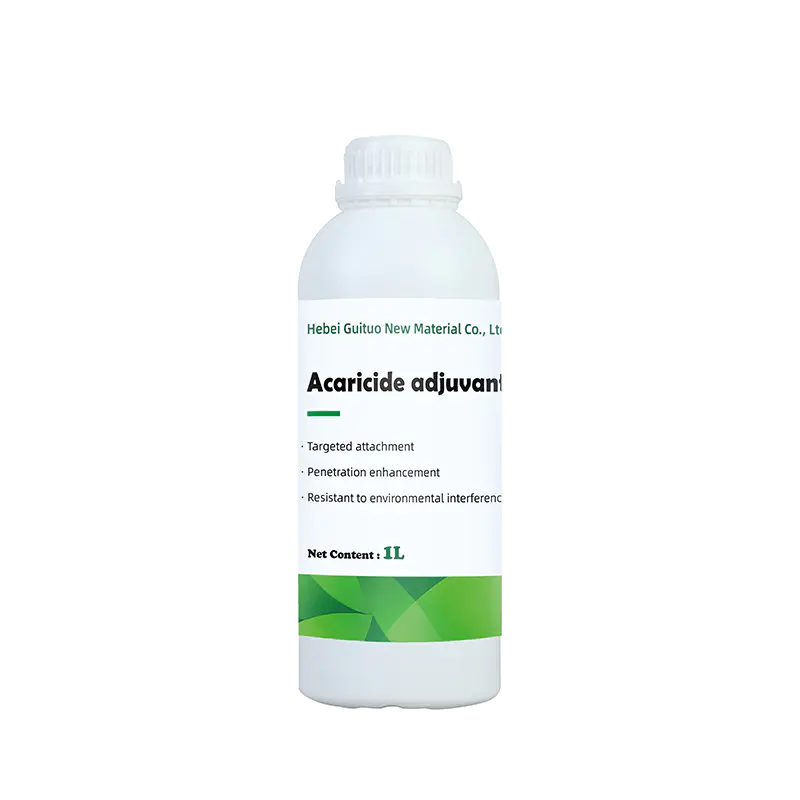
Regardless of the pesticide chosen, because mites have the habit of spinning silk webs, the liquid medicine often remains suspended on the silk and cannot contact the pest body. The addition of Agricultural Mite-Killing Adjuvants significantly changes the physical properties of the spray, allowing droplets to spread flat on the leaf and penetrate the leaf underside through gaps in the silk webbing.
The Science of Penetration: Why Adjuvants are Non-Negotiable
Many growers wonder: Why is the control effect still poor even after choosing a top-ranked pesticide? The answer often lies in the lack of "Wetting and Penetration."
Breaking the "Hydrophobic Barrier" of Leaves
Most agricultural crops (such as citrus, apples, and cotton) have surfaces covered with a thick waxy layer or dense fine hairs. Pure water solutions have a large contact angle on these surfaces and roll off easily.
Agricultural Mite-Killing Adjuvants lower the surface tension of the liquid from 72 mN/m (water) to approximately 20-25 mN/m.
Parameter Comparison: Spreading Ability
Plain water: Spreading area 1x
Conventional surfactant: Spreading area 2-5x
Professional Agricultural Mite-Killing Adjuvants (e.g., organosilicon): Spreading area can reach 10-20x.
Precision Strike on "Invisible" Targets
Mites usually hide on the underside of leaves, especially along the leaf veins. Conventional spraying rarely hits these areas directly.
Penetration Mechanism: High-quality Agricultural Mite-Killing Adjuvants have strong stomatal penetration capabilities. The liquid enters the leaf tissue through the plant's stomata, achieving a "kill from the inside out" effect.
Enhanced Ovicidal Effect: Ovicides (like Etoxazole) need to completely wrap around egg clusters to prevent hatching. Adjuvants allow the liquid to flow automatically into the gaps of the egg clusters, ensuring no dead ends in coverage.
Enhanced Rain Fastness
The peak period for mites often coincides with summer thunderstorms. After adding adjuvants, the medicine can quickly adhere to and form a protective film on the leaf epidermis. Even if rain occurs 1-2 hours after application, the efficacy can still be maintained at over 80%.
Maximizing Efficacy: Synergetic Tank Mixing Strategies
In miticide applications, the design of "pesticide combination" and "adjuvant synergy" is the key to determining final control efficiency.
The Golden Ratio: Pesticide + Agricultural Mite-Killing Adjuvants
To achieve the best kill rate, the mixing ratio of the miticide to the Agricultural Mite-Killing Adjuvant is crucial.
General Dosage Recommendation: It is generally recommended to maintain a concentration of 0.05% - 0.1% for the adjuvant in the diluted solution (i.e., adding 0.5 to 1 liter of adjuvant per 1000 liters of water).
Physical Stability Parameters: When tank mixing, the miticide must be fully dispersed in water first (especially for WP or SC formulations), and the Agricultural Mite-Killing Adjuvant should be added last. This ensures the adjuvant does not disrupt the suspension system.
Efficacy Improvement Comparison of Different Combinations
| Experimental Combination | Mortality 3 Days Post-Spray | Mortality 14 Days Post-Spray | Leaf Underside Coverage |
| Spirodiclofen + Pure Water | 45% | 72% | 15% - 20% |
| Spirodiclofen + Household Detergent | 55% | 75% | 35% |
| Spirodiclofen + Agricultural Mite-Killing Adjuvants | 85% | 98% | 85% - 90% |
Overcoming Resistance: Integrated Pest Management (IPM)
Rotation of Modes of Action
Do not use miticides with the same classification code consecutively within the same growing season. For example, after using a Group 23 (LBI Inhibitor) like Spirodiclofen, the next spray should choose Group 25 (Cyflumetofen) or Group 20B (Bifenazate).
The Invisible Contribution of Adjuvants to Resistance Management
Agricultural Mite-Killing Adjuvants play a physical intervention role in resistance management:
Complete Eradication: Resistance often arises when low-dose applications allow a few mites to survive and pass on their genes. Adjuvants ensure a high "thorough kill rate" in a single application, reducing the chance for resistant individuals to reproduce.
Physical Suffocation: High-quality Agricultural Mite-Killing Adjuvants can physically block the spiracles (breathing holes) of mites during the film-forming process, providing a physical kill mechanism that does not trigger chemical resistance.
Application Technology: From Nozzle to Leaf
Balancing Droplet Size
Fine Droplets (less than 200 micrometers): Provide better coverage area but are easily drifted and evaporated.
Medium Droplets (200 - 400 micrometers): The best choice for miticides. Combined with Agricultural Mite-Killing Adjuvants, even larger droplets can spread rapidly upon hitting the leaf.
Spray Pressure and Water Volume Parameters
High-Pressure Spray: Recommended pressure is 1.5 - 2.5 MPa. High pressure helps disturb the leaves, allowing the liquid to enter the interior of the tree canopy.
Water Volume Requirements: For evergreen fruit trees like citrus, the water volume per acre should reach 150 - 300 liters. Adding Agricultural Mite-Killing Adjuvants at this stage significantly reduces liquid runoff.
FAQ: Expert Answers to Common Miticide Questions
Why did my miticide fail even though I used the highest dosage?
This is usually not a dosage problem but a "contact problem." Red spiders often hide on the underside of dense foliage. Without using Agricultural Mite-Killing Adjuvants, the liquid cannot penetrate the silk webs and hairs. Additionally, serious resistance may have already developed.
Are all surfactants the same as Agricultural Mite-Killing Adjuvants?
Not exactly. Professional Agricultural Mite-Killing Adjuvants are optimized for the chemical characteristics of pesticides, offering stronger penetration and lower phytotoxicity risks, whereas household detergents may contain ingredients that damage the leaf's waxy layer.
Can I mix miticides with foliar fertilizers?
Most miticides can be mixed with neutral foliar fertilizers. However, the high penetration of Agricultural Mite-Killing Adjuvants also increases the risk of fertilizer burn. It is recommended to perform a "jar test" for precipitation before large-scale use.
How soon can I see results after spraying?
It depends on the pesticide type. Neurotoxins (like Bifenazate) usually show results within hours, while metabolic inhibitors (like Spirodiclofen) may take 3-5 days to see significant adult mortality.
Is it safe for beneficial insects (predatory mites)?
Many modern miticides like Bifenazate and Cyflumetofen are relatively safe for predatory mites. Using them with Agricultural Mite-Killing Adjuvants can reduce the overall frequency of pesticide use, thus better protecting the ecosystem.
Science Insight: The "Umbrella Effect" of Red Spiders
Mites create a natural "umbrella" for themselves by secreting silk webs and utilizing the uneven structure of the leaf underside. Ordinary liquid medicine, affected by surface tension, slides off like rain on an umbrella. The principle of Agricultural Mite-Killing Adjuvants is to break this "umbrella," allowing the medicine to soak into every crevice like glue.

Contact Information
Tel : +86-400-138-5268
Email : [email protected]
Phone : +86-15128434888 / +86-13511051998
Add : Xinqiao Environmental Protection Industrial Park, Wen'an County, Langfang City, Hebei Province, China
Contact Information
Copyright © Hebei Guituo New Material Co., Ltd. All Rights Reserved.
